
React adapter roots
A React root is an entry in vgai.project.json.roots whose adapter is dom.
It mounts as a DOM layer in the same z-ordered host stack as gameplay canvases:
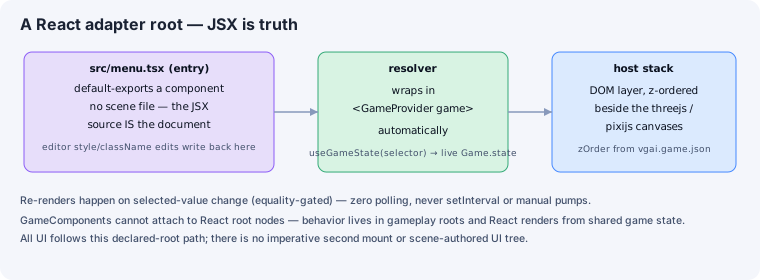
{ "manifestVersion": 2, "roots": [ { "id": "main", "adapter": "three", "entry": "src/world.tsx" }, { "id": "menu", "adapter": "dom", "entry": "src/menu.tsx", "zOrder": 10 } ]}The entry module default-exports a component. The host wraps it in the engine
WorldProvider, so it can subscribe to live state without a local provider shim:
import { useWorldState } from '@engine/react/world-state';import { getHudState } from './game-state';
export default function Menu() {  const hud = useWorldState(() => getHudState());  return <button style={{ pointerEvents: 'auto' }}>HP: {hud.health}</button>;}
JSX is truth
Section titled “JSX is truth”A React root has no scene file. The editor derives its hierarchy from stable OID instrumentation in the served TSX, and inspector edits write back to JSX. React nodes do not host per-frame gameplay; behavior lives in gameplay roots and the React tree renders from shared game state.
Lifecycle and input
Section titled “Lifecycle and input”The manifest composer mounts and disposes React with every other root. Layers
are click-through by default; interactive elements opt in with
pointer-events: auto.