
Ingesting unmodified games
The headline capability: vgai’s editor can load and edit a three.js game it didn’t author, without modifying the game’s code.
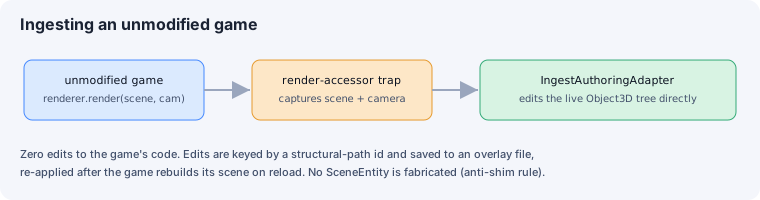
The render-accessor trap
Section titled “The render-accessor trap”IngestRootAdapter (packages/editor/src/authoring/ingest-root-adapter.ts) captures an
unmodified game’s live scene + camera via the render-accessor trap — it observes the
game’s own renderer.render(scene, camera) call to grab the objects, with zero edits to the
game. It returns a MountedRoot that drives its own loop.
After capture, the host adopts the game’s canvas into the editor’s game pane. A hybrid
DOM+canvas game — a React/R3F app with HTML HUDs, overlay panels, or drei <Html> portals —
can declare the element that owns its canvas by setting window.__vgaiGameRoot in its entry
module; the host then adopts that root wholesale, so the game’s DOM UI travels with its
canvas instead of stranding at page level over the editor chrome. Games that declare nothing
keep the bare-canvas behavior. The whole game-side obligation is ordinary embed hygiene: create
a container, mount into it, declare it, and keep your own position: fixed UI contained
(transform: translateZ(0) on the container).
Editing the live tree (anti-shim)
Section titled “Editing the live tree (anti-shim)”LiveThreeAuthoringAdapter implements the AuthoringAdapter directly over the live
Object3D tree — it does not fabricate a SceneEntity. It is the same adapter that drives
a first-party live scene, parameterized by an identity provider: a foreign game gets
structuralIdentity, so nodes get structural-path ids (stable across reloads) and
selection/transform/inspector work on the foreign objects as-is.
Persistence is ownership-based
Section titled “Persistence is ownership-based”Vendored reference copies are live-only: edits drive the running game and nothing persists them — the vendored source is never touched. A game you own persists through the ingest-authoring model: edits become ordinary source edits in YOUR files. There is no sidecar of any kind.
See also
Section titled “See also”- The adapter architecture — the interfaces this builds on.
- Ingested games in the gallery — how real upstream games enter, byte-for-byte verified.