
Inverse kinematics
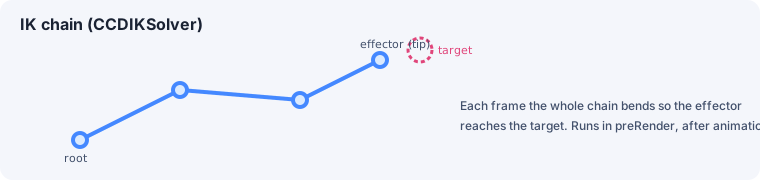
Inverse kinematics (IK) computes the joint rotations needed for a chain’s tip to reach a
target — the inverse of forward animation. The copied ik capability provides IKChain
(src/lib/ik/ik-chain.ts in any project with the capability; the
shooter examples are worked users), wrapping Three.js’s own
CCDIKSolver. Its flagship use is
the held-item grip convention’s off hand: the drivers point an IKChain
at a held item’s Foregrip node so the second hand makes real contact —
see the humanoid skill’s “Held items” section.
IKChain
Section titled “IKChain”IKChain operates on a subtree containing a SkinnedMesh. Configure it, call init() once,
then call update() from the owning component’s useFrame after clip sampling and procedural
posing. It bends a named chain so the effector reaches an ordinary hierarchy object or
world-space position. TwoBoneIK adds the familiar root/middle/tip chain and pole target.
Important inputs:
boneNames— bone names from chain root → effector (the tip that reaches the target).targetBoneName— the skeleton bone used as the IK goal. If no bone with that name exists, one is appended to the skeleton (and the skin’s bone buffers grown) — so IK works on any rig.targetOffset— a world-space target position to use when no live target is provided.iterations— CCD solver iterations per frame.targetObject— an ordinaryObject3Dused as the hierarchy-visible goal.poleObject— the bend-direction control for Two Bone IK.
See also
Section titled “See also”- XState animation binding — the pose IK refines.
- Shipped examples — first- and third-person games using the copied capability.
- Entities & world code — where the owner calls the solve.